WordPress Is Shrinking. What I See From Inside.
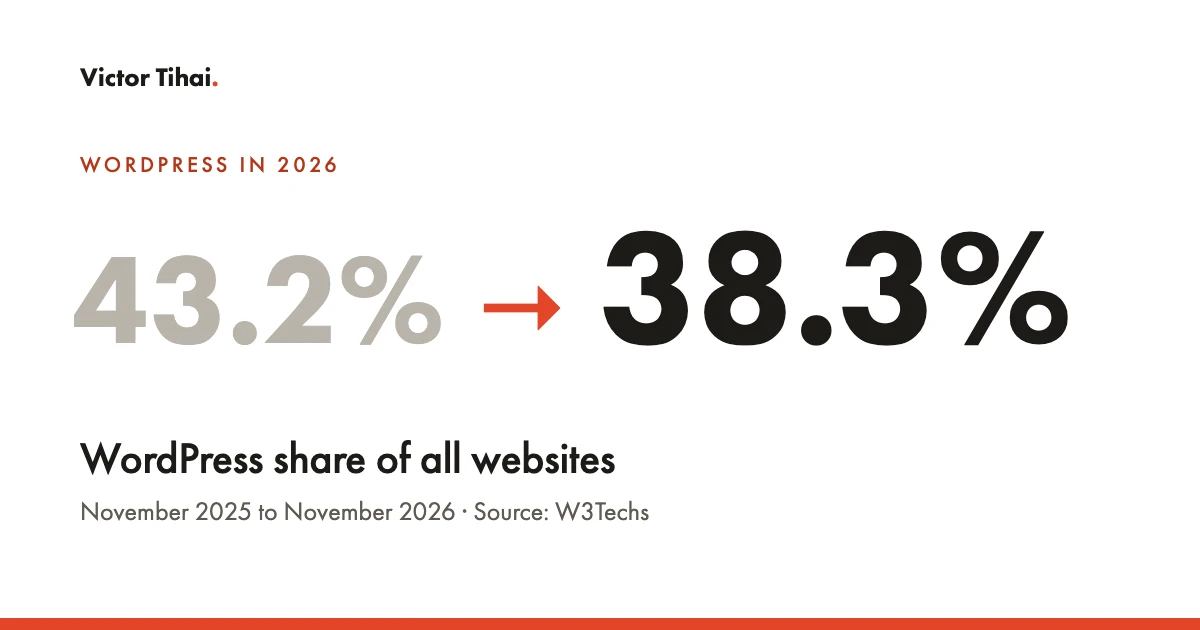
WordPress fell from 43.0% to 38.3% of all websites between January and November 2026. Most of those sites went to custom builds, static sites and AI tools, while Wix, Squarespace and Shopify barely moved. WordPress is still the largest CMS, with 57% of the sites whose CMS can be detected.
I have built with WordPress since 2005. For most of those years, nobody asked whether to use it. The question was which theme and which plugins.
That changed in 2026.
The numbers come from W3Techs. Almost five points in eleven months is a lot for a platform that grew slowly for more than ten years and only dipped a little in 2025. The direction has changed, and people in the WordPress business feel it.
Show data
| Date | Share of all websites |
|---|---|
| Nov 2025 | 43.2% |
| Dec 2025 | 43.2% |
| Jan 2026 | 43.0% |
| Feb 2026 | 42.8% |
| Mar 2026 | 42.7% |
| Apr 2026 | 42.5% |
| May 2026 | 42.2% |
| Jun 2026 | 41.9% |
| Jul 2026 | 41.5% |
| Aug 2026 | 41.2% |
| Sep 2026 | 40.7% |
| Oct 2026 | 40.2% |
| Nov 2026 | 39.5% |
| Nov 28, 2026 | 38.3% |
Source: W3Techs, 28 November 2026.
Where did the WordPress sites go?
You would expect Wix, Squarespace or Shopify to pick up what WordPress lost. They mostly didn’t. Over the same eleven months Wix stayed at about 4%, Squarespace at 2.4%, and Shopify grew from 5.0% to 5.5%.
The big change is in sites where W3Techs can’t detect any CMS. That group grew from 28.6% to 33.1% of the web.
Show data
| Platform | 1 Jan 2026 | 28 Nov 2026 |
|---|---|---|
| WordPress | 43.0% | 38.3% |
| No CMS detected | 28.6% | 33.1% |
| Shopify | 5.0% | 5.5% |
| Wix | 4.2% | 4.1% |
| Squarespace | 2.4% | 2.4% |
Source: W3Techs.
Those are custom builds, static sites, and more and more sites made with AI tools. Lovable, an AI app builder, appeared in the W3Techs list for the first time this month. Someone who needs a simple site can now describe it to an AI tool and have it online the same afternoon, with nothing to install or update.
This site is one of them. It ran on WordPress until this month. Now it is a static site with no database and no plugins.
Did the Automattic and WP Engine fight hurt WordPress?
In September 2024, Matt Mullenweg, who co-founded WordPress and runs Automattic, publicly went after WP Engine, one of the largest WordPress hosts. Automattic blocked WP Engine from WordPress.org and took over the plugin listing of Advanced Custom Fields, which WP Engine owns, replacing it with its own fork. WP Engine sued. A court ordered the access restored in December 2024, and two years later the case is still going.
In 2025 Automattic also cut back its work on WordPress core, and the project shipped two major releases that year instead of the usual three.
For most site owners the details of the case don’t matter much. What matters is how it looks to a company choosing a platform for the next ten years. A public fight over who controls WordPress is a reason to pick something else. The share started slipping in 2025 and fell faster in 2026. I can’t prove the fight caused it, and it certainly didn’t help.
Why are WordPress theme sales down?
I have sold WordPress themes since 2010, and our sales of premium themes have dropped over the last few years.
The biggest change came from inside WordPress. The block editor, Gutenberg, arrived in WordPress 5.0 in 2018, and Full Site Editing followed in 2022. A classic theme was a complete product, with its own layouts, options, widgets and features. A block theme is mostly a theme.json file, some templates and a set of patterns, and users can rebuild much of it in the editor themselves. That is good for users and hard for a theme business. Each major release can change how blocks, styles and patterns behave, so a block theme needs regular work just to keep up.
The other reasons I see:
- ThemeForest is overloaded, and the other theme marketplaces are practically dead. On ThemeForest too many authors sell almost the same theme, and it is very hard to stand out when everyone offers the same things.
- Elementor and the other page builders took a big part of the market. Many people buy one builder and use it with any theme, often a free one. Many site owners never moved to blocks at all, so a theme shop ends up supporting two ways of building the same site.
- Free block themes and the patterns that ship with WordPress now cover a lot of what a premium theme used to add.
- Buyers who used to pick a theme and customize it now want the whole site done, by an agency or by an AI tool.
I sold on ThemeForest for years and made almost 8,000 sales there. In 2015 I stopped, before Envato started handling invoicing for authors, because selling under their terms didn’t fit well with the rules for a business registered in Québec. To stay fully legal, I moved all sales to our own store at wplook.com. I also sold on Creative Market, but it never had the pull ThemeForest had in its best years.
We also never sold cheap. Our themes have always cost $75 to $99, and $129 with a developer license. A $59 price doesn’t bring more sales. Someone spending a few thousand dollars on a website won’t choose a theme to save $20. They choose the one that fits the project.
The other thing we did early was selling our themes by subscription. We switched in 2017, before most of the market was ready for it. It was one of the best decisions I made, and it is a big part of why the business kept running when single-theme sales fell. Looking back, I still think I did it too late.
We also keep every theme up to date. They work with both the Customizer and the block editor, and they run on PHP 8.5. Customers who keep their WordPress sites updated can keep using the same theme for years without rebuilding.
New themes are a different story. Getting a new theme noticed is harder every year, so I don’t expect to release many more. Our time goes into keeping the existing ones current.
Who owns the WordPress plugin market?
When I started, most popular themes and plugins came from small teams like mine. Over the last ten years, a few large companies bought a big part of that market:
- Automattic bought WooThemes, including WooCommerce, in 2015. It also owns Jetpack and Akismet, and runs its own store for WooCommerce extensions.
- WP Engine bought StudioPress, the company behind the Genesis framework, in 2018, and Advanced Custom Fields in 2022.
- Newfold Digital, which owns Bluehost, bought Yoast in 2021.
- Liquid Web, a hosting company, owns The Events Calendar, LearnDash, GiveWP and Kadence.
- Awesome Motive owns WPForms, MonsterInsights and All in One SEO.
They saw money in WordPress, and they were right. For independent authors, it made the business harder.
The big companies give the base plugin away and sell add-ons and yearly licences, so buyers now expect the core features for free. They have the marketing budgets, the reviews and the top spots in the plugin directory. Many of them also run hosting, so their plugins come preinstalled on new sites. When a small author’s feature sells well, a big company adds it to its own bundle or buys the plugin that does it.
The same company can also own the platform, the hosting and the plugins. Automattic runs WordPress.com, WooCommerce and Jetpack, and its CEO personally controls WordPress.org, where every free plugin and theme is listed. The ACF case showed that a listing can be taken away from its author. For anyone building a business on WordPress, that is a real risk.
What still grows in the WordPress business?
The part of our business that keeps growing is hosting and maintenance.
38% of the web is still an enormous number of sites. Every one of them needs updates, backups, security fixes, PHP upgrades and someone to call when something breaks. A WordPress site that earns money doesn’t change platforms because a market share chart went down. It needs to stay fast and keep working.
Speed is where most of them fall short. Many developers learned to build WordPress sites without writing code, using a theme that does everything and a plugin for each feature. Often one feature ends up needing three plugins. I have found sites with 70 to 80 plugins installed, and their owners complain that WordPress is slow. Put that on cheap hosting with no caching and pages take several seconds to load. Fixing it is plain work, and it pays off for years.
This is why we run WPL Hosting, web and WordPress hosting in Canada with servers in Québec. Your site and its data stay in Canada, and the people who look after the servers also build and fix WordPress sites, so a slow or broken site gets fixed at the source.
Should you still build on WordPress?
It depends on the site more than on the market share.
| Your site | WordPress? | Why |
|---|---|---|
| Several people publish content, with roles and an editorial workflow | Good fit | User roles, revisions and scheduling are built in |
| You need a store, memberships or several languages | Good fit | Mature plugins already exist, like WooCommerce |
| The site will grow for years and you want to own it | Good fit | It runs on any host, and many developers know it |
| Five pages that rarely change | Probably not | A static site costs less to run and has less that can break |
| One person updates it a few times a year | Probably not | Plugin, theme and core updates are more upkeep than the site needs |
What comes next for WordPress?
WordPress will be around for a long time. It is losing the small, simple sites first, because those never needed a full CMS. The sites that stay are the ones that use what WordPress does well: lots of content, several editors, plugins and full ownership.
How we work with those sites is changing too, because of AI. More and more, we don’t work in wp-admin. Content, settings, updates and fixes go through the REST API, WP-CLI and AI agents like Claude Code, which can read a site, change it and check the result. WordPress becomes the place where the content lives, and the dashboard is one way in among several. Maybe, in the end, most of the work on a WordPress site will happen this way.
For the people who build with it, that means less money in selling themes to beginners and more in looking after serious sites properly. That is where I’m putting my time.
FAQ
Is WordPress dying?
WordPress still runs about 38% of all websites and 57% of the sites whose CMS can be detected (W3Techs, November 2026). It is shrinking, mostly among small and simple sites, which now often go to static site generators and AI site builders.
Why is WordPress losing market share?
Several things happened at once. AI tools and static sites became an easy choice for simple projects. The legal fight between Automattic and WP Engine made some businesses nervous about the platform. The block editor made themes harder to build and sell, and a few large companies bought much of the theme and plugin market, which left less room for independent authors.
Which companies own the biggest WordPress plugins?
Automattic owns WooCommerce, Jetpack and Akismet. WP Engine owns Advanced Custom Fields and the Genesis framework. Newfold Digital, the owner of Bluehost, owns Yoast. Liquid Web owns The Events Calendar, LearnDash, GiveWP and Kadence. Awesome Motive owns WPForms, MonsterInsights and All in One SEO.
Should I move my WordPress site to another platform?
If the site is small, has a few pages and rarely changes, a static site or a site builder can cost less to keep. If it earns money, has several editors, or depends on WooCommerce or other plugins, better hosting and regular maintenance usually help more than a move.
Are premium WordPress themes still worth buying?
For a simple block theme, the free ones on WordPress.org cover most needs. A paid theme makes sense when it includes features and support that would otherwise cost you a developer's time.